
Nobody asks for their worn-out part back. We do.
A worn-out component is the only honest record of what a position does to steel. OPC takes it back, sections it, measures what is left, and adds deposit where the bore actually opened up — on the next production run of that same part number. Same number, same envelope, same fit.
Collect
Removed components come back to OPC. Red enamel is on the part for this reason — it is identifiable in a scrap bin after the paperwork has parted company with the steel.
Inspect
Sectioned and photographed. Where the deposit breached and where it did not; what the flow pattern did at that position; whether the failure was wear, impact, or something upstream of the part.
Measure
Remaining deposit mapped around the bore and along the length, against tonnage through the position where you have it. The record goes back to you with the report.
Reinforce
Additional hardfacing is added in the wear-through zone on the next run of that part number. Same number, same envelope, same fit — more deposit where the position actually eats it.
Why this is a small-supplier advantage.
A large supplier builds a catalogue part to one specification, in volume, in a plant tooled for exactly that. Changing the overlay on one component, for one position, at one mine is a product-line decision — and it competes against every other demand on that plant.
OPC's fabrication is a Northern Ontario shop with capacity available and no committee between the observation and the next run. A change identified on a part returned in March can be in the steel you receive in May. That is the whole advantage of dealing with someone this size.
What it is aimed at.
The objective is a lower installed cost per tonne at the positions that govern the changeout schedule — not a longer part in general, but a longer part there. Each returned component is meant to make the next one better than the last, and the loop only closes if the worn-out part comes back.
What OPC needs from site
The removed part, the position it came out of, and the changeout date. Tonnage through the position if the maintenance record carries it. Nothing else, and nothing that has to leave your system.
It starts with one component. No line, no contract, no trial protocol — one removed elbow, one position, one report. Everything after that is your call.
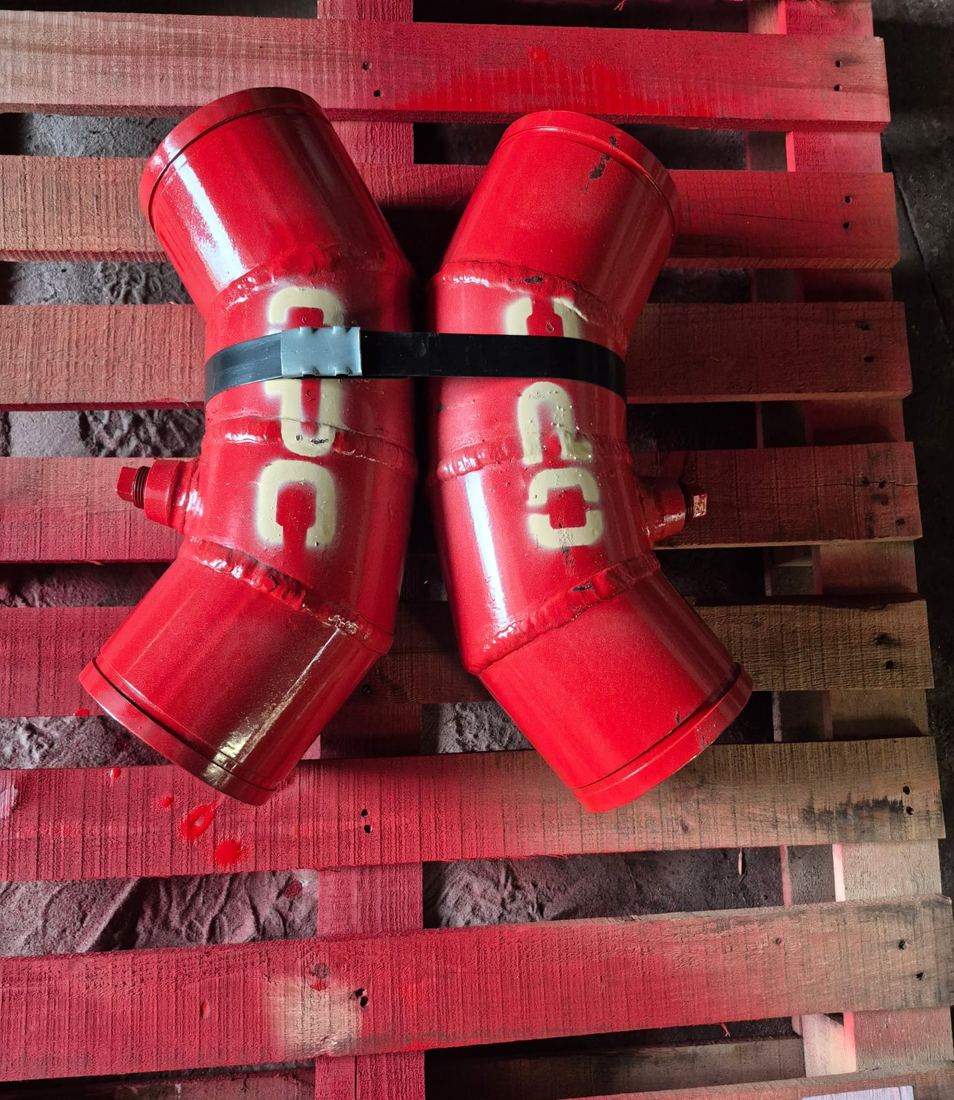
Red enamel because parts outlive their paperwork — identifiable in any scrap bin.
Positions vary by line. This is the shape of the problem, not a survey of yours — that is what the line survey is for.
| # | Position | Why |
|---|---|---|
| 1 | Collar / hole entry | Direction change at full velocity, often a restriction |
| 2 | Top-of-hole bend | The column turns while still carrying surface energy |
| 3 | Deflections in the vertical | Every degree puts the stream on one side of the bore |
| 4 | Bottom-of-hole bend | Impact and abrasion together — usually the governing position |
| 5 | Level tie-in tee | Branch entry — rarely on a protection list |
Start with one component.
One removed elbow, one position, one report.
Reading the worn part — what a removed component tells you, and what sectioning changes on the next run.